
A Season of Gratitude: Vesak Grand Celebrations Conclude with Joy and Compassion 无尽感恩的季节:卫塞盛典 圆满落幕
The annual Vesak celebrations at Kong Meng San Phor Kark See Monastery (KMSPKS) unfolded over 30 and 31 May, guided by the theme “Season of Gratitude”. Rather than a single weekend of activity, the programme developed as a gradual unfolding of ritual, reflection and community engagement, where different forms of practice quietly coexisted and informed one another.
In Buddhist understanding, gratitude is not limited to sentiment. It is closely tied to awareness of conditions, and the recognition that life is sustained through interdependence and unseen acts of care. This perspective formed a quiet backdrop to the season as it took shape.
Preparatory activities had already begun well before the main days. Initiatives such as Hair for Hope and the Blood Donation Drive reflected a simple orientation found across Buddhist traditions: that compassion becomes meaningful when it moves from intention into action, expressed through care for others in practical ways.
This tone of quiet intention continued with the Light Transference and Aspiration Ceremony on 23 May. As lamps were passed from candle to candle, the movement of light created a slow unbroken chain across the gathering. Each flame carried both symbolic meaning and human presence, pointing to clarity as something shared rather than individually owned. As the lights gradually converged, the atmosphere settled into stillness rather than spectacle.
On Vesak eve, the Three Steps, One Bow ceremony brought participants into a measured rhythm of movement and pause. The act of bowing, repeated over distance and time, became less about progression and more about attention. Each step marked a deliberate letting go of urgency and self-reference. Despite a revised route due to upgrading works within the monastery, the practice retained its continuity through presence rather than form.
Throughout the two days, the Bathing of Prince Siddhartha ritual offered a quieter counterpoint. Devotees gently poured water over the infant Buddha, an act often understood as symbolic cleansing. Its simplicity pointed more directly to practice itself, the ongoing recognition of mental habits and the possibility of renewing one’s orientation in any moment.
On Vesak Day, the Thousand Buddhas Repentance Puja filled the hall with chanting and prostrations. The repetition of sound and movement established a steady cadence, within which individual awareness blended into collective rhythm. Reflection here was not framed as analysis, but as direct attentiveness, a pause within action rather than something separate from it.
Outside the halls, the monastery grounds carried a different tempo. The Vegetarian Food Fair and Charity Booths formed a natural gathering point where visitors paused, ate and moved through the space at ease.
Nearby, activity spaces offered more hands-on engagement. Workshops in crafts, terrariums and floral arrangement encouraged focus through making, where attention was drawn into detail, texture and care. In the Family Activities Corner and Experiential Workshops, sutra tracing, clay work and Dharma-inspired games provided accessible entry points for younger participants and families, allowing tradition to be approached through touch, curiosity and shared activity.
Beyond the physical gathering, the Online Pledge of Sakyamuni’s Name Chant extended participation beyond the monastery grounds. Practice continued in ordinary settings, at home, at work and in transit, suggesting that remembrance is not limited by location but shaped by continuity of attention.
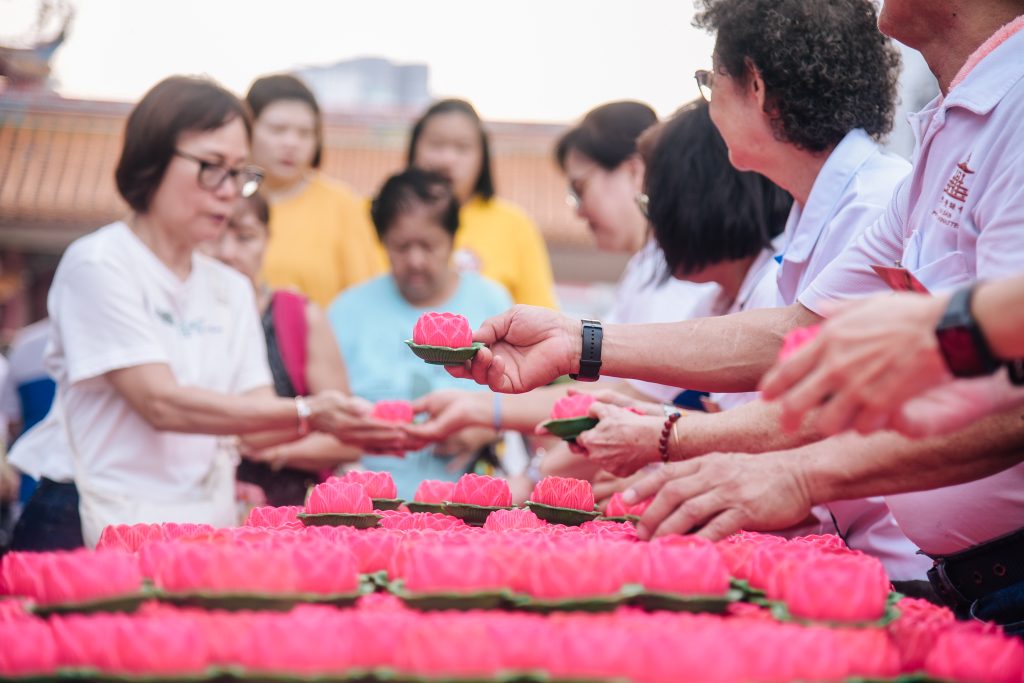
The period also included offerings of light. Vesak lanterns placed before the Buddha expressed aspirations for peace, harmony and well-being, while lotus lamps symbolised clarity within changing conditions. Rather than functioning as decorative elements, these acts of offering reflected a familiar Buddhist emphasis on intention made visible through simple gesture.
Taken together, the celebrations showed a tradition expressed through multiple modes of engagement, contemplative, social and participatory. What connected them was less a single message than a shared orientation, the possibility of returning, repeatedly and in ordinary ways, to awareness shaped by care.
Vesak celebrations at KMSPKS ultimately reflected the monastery’s ongoing commitment to making Buddhist practice accessible, lived and relevant within contemporary society. Rather than positioning tradition as something distant or purely ceremonial, the Vesak programme showed how KMSPKS continues to hold space where devotion, learning and community life can meet in a grounded and inclusive way. In this sense, Vesak was not only an annual observance, but an expression of the monastery’s wider aspiration — to nurture conditions where individuals can encounter the Dharma through everyday experience, and gently return to awareness, compassion and gratitude in their own lives.
光明山普觉禅寺(KMSPKS)的年度卫塞盛典于5月30日至31日庄严举行。今年庆典以“无尽感恩的季节”为主题,这不仅是一场节日的欢聚,更是一段将仪轨、反思与社区善行融为一体的修行历程。在欢喜祥和的氛围中,数千信众以信仰为纽带,共同交织出一幅感恩承续的动人篇章。
佛法中的感恩,超脱于感性的共鸣。它是一种对因缘的通达,亦是对生命互为依存的深切觉知——唯有洞见众生互为关怀的无形纽带,方能领悟生命延续的本质。这一份清醒的认知,亦是贯穿整个卫塞季最静谧的底色。
修持的法音,早在盛典前便已敲响。散发希望(Hair for Hope)与捐血等公益活动,实践了佛教慈悲最质朴的初心:当悲悯之心不再停留于祈愿,而是化作利他的具体行持,那份关怀便有了真实的温度。
5月23日,传灯与许愿仪式拉开了庆典的序幕。烛光在信众间流转,宛如一道长明的心灯长链。每一份灯火的传递,皆象征着智慧并非个人的独占,而是众生共享的无上法喜。随着灯火渐次汇聚,现场没有喧哗,只有静水流深般的祥和。
卫塞节前夕,三步一拜将参与者带入了一种身心统一的律动。跪拜的意义,不在于路程的远近,而在乎当下的摄心。每一躬、每一拜,皆是卸下焦躁与自我执念的历程。即便活动路径因道场修缮而有所调整,但那份修行中的专注与虔诚,依然如故,绵延不断。
庆典期间,浴佛仪式如清泉般涤荡身心。信众以香汤灌沐太子圣像,这不仅是形式上的仪式,更是在提醒大众随时观照内心,洗去尘劳,在每一个当下重焕清净。
卫塞节当天,大雄宝殿内梵音缭绕,礼拜千佛法会以至诚的诵经礼赞,让大众将微渺的个人觉知,安放在集体共修的宏大节奏之中。此间的内省,并非逻辑的推演,而是于动中取静,在礼赞与顶礼的起落间,觅得那一抹纯粹的专注。
殿堂之外,寺院处处流转着自在的人间烟火与法喜。在素食慈善义卖的摊位前,大众相聚交谈,从容享受当下的欢愉。
在各类工作坊里,手作艺术化作了禅意的载体:于花艺的线条与泥塑的纹理中,人们收摄纷扰,体验专注之美。亲子活动区内,抄经的静谧与游戏欢声交相辉映,让佛法智慧以亲切的方式,在年轻一代的心田中播下传承的种子。
此外,线上的念佛持名修持,让这份正念超越了时空与地域。无论是在居家、通勤还是工作的空隙,修行始终如影随形。这些活动也启示我们:怀念与感恩,从不取决于身在何处,而在于心念的那份持之以恒。
在此,一盏盏莲花灯象征着于无常变幻中持守清明,一份份供灯表达了对众生和平的衷心祈愿。这些供养行为,皆是内心愿力在简约仪式中的诚恳投射。
纵观整场盛典,它展现了佛教传统在现代语境下的多样样貌——既有沉思的庄严,亦有社区的温情与参与的欢喜。这一切的终极指向,在于让我们在繁忙的日常中,反复回归那份由慈悲与智慧交织而成的觉知。
光明山普觉禅寺始终致力于让佛法更贴近现代脉动,让信仰与生活在包容中交汇。卫塞节的意义,不仅在于年度的欢庆,更在于为社会培育了一片厚土,让每个人都能在日常体验中参透佛法,在各自的生命里,温润地回归那份感恩、慈悲与自性的觉知。